

A few years ago, getting your brand onto the first page of Google felt like the big win. It still matters. But there’s another place businesses are starting to compete for attention: the answer itself.
Ask an AI tool for a product recommendation, a local service, or a comparison, and you may get a list of brands without visiting a single website. That’s a big change in how people discover businesses.
So, why does one brand get mentioned while another doesn’t? There isn’t a magic switch. And honestly, nobody outside these platforms knows exactly how every answer is generated. But a few patterns are becoming easier to spot.
AI Needs Enough Information to Understand Your Brand
Imagine being asked to recommend a company you know almost nothing about. You’d probably hesitate. What do they sell? What are they actually good at?
AI systems have a similar problem. They need enough information to form a picture of a business. Understanding how AI platforms discover and understand a brand is an important part of improving its visibility in AI answers.
If your website clearly explains what you offer, who you serve, and what makes your products or services different, there’s simply more to work with. This is one reason vague website copy can hurt. Saying you’re a ‘leading solutions provider’ doesn’t tell anyone much. What do you actually do?
Useful Content Gives AI More to Work With
A brand that answers real questions is giving people and AI something useful to find. Product guides, FAQs, comparisons, how-to articles, and detailed service pages can all help explain what a company knows.
We’ve seen businesses spend a lot of time trying to make content sound impressive. Sometimes, the simpler article wins.
If someone asks, “Which type of air cooler is better for a small desk?” an article that actually answers that question is more useful than a page stuffed with phrases like ‘best cooling solutions’.
The question comes first. Your content should too.
What Other Websites Say Matters
Your own website can tell people that you’re an expert. But it’s not the only voice in the room.
AI platforms can use information from different sources when putting an answer together. Mentions in relevant publications, reviews, business directories, and industry websites can help create a fuller picture of a brand.
Think of it like word of mouth. If you only say your business is good, people may take it with a pinch of salt. When several independent sources mention you, it feels different.
A Real Example: Macadve Appearing in an AI Answer
The screenshot below gives us a simple example.
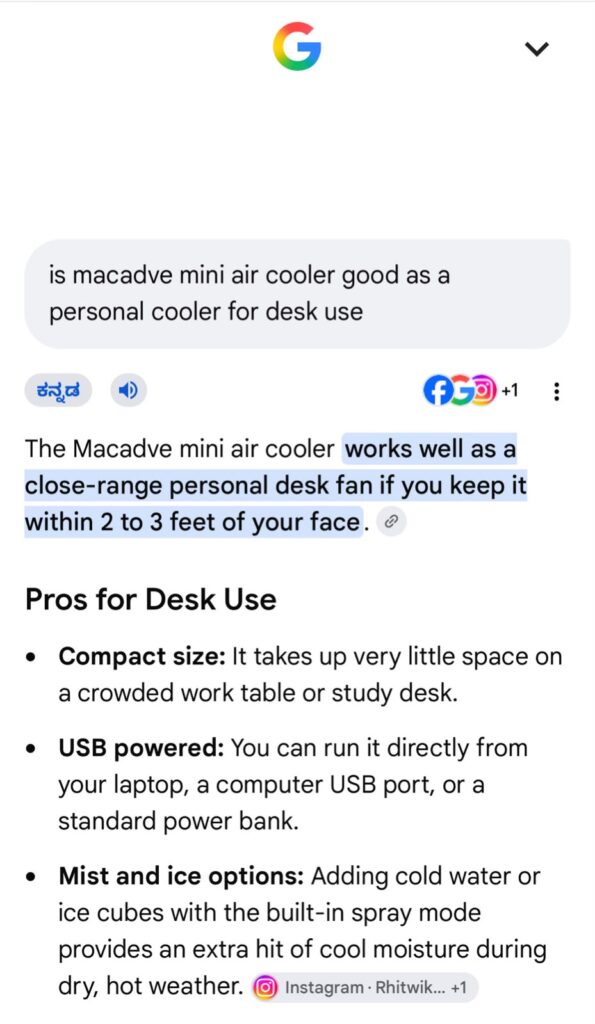
A user searched Google for “Is the Macadve Mini Air Cooler good as a personal cooler for desk use?”
The answer shown in the screenshot directly discusses the Macadve Mini Air Cooler. It mentions that the product works well as a close-range personal desk fan and points out details such as its compact size, USB power, and mist and ice options.
What’s interesting here is the level of detail. The answer isn’t just saying, “Yes, Macadve is good.” It uses specific product information to explain why.
That’s an important lesson for brands. Generic claims don’t give AI much to work with. Clear product details, useful explanations, and answers to real customer questions do.
Make Your Brand Easy to Understand
There’s another part businesses sometimes overlook: consistency.
Your website, product pages, social profiles, and other online references shouldn’t tell completely different stories. Product names, company descriptions, and basic information should make sense wherever someone finds them.
And yes, the technical side matters too. A website that is difficult to crawl, poorly structured, or full of confusing information isn’t doing your content any favor.
AI Visibility Isn’t a One-Time Project
You can’t publish a few articles, change some website pages, and assume the job is finished. Search behavior changes. AI tools change. Your own products and services change too.
At Webfosys Ventures, we look at what a brand says about itself, what others say about it, how clearly its information is presented, and whether its content answers questions potential customers are actually asking.
Will that guarantee a brand appears in every AI answer? No. Nobody can honestly promise that. But giving AI better information, building a stronger reputation online, and making your brand easier to understand gives it a better chance of being part of the conversation. And increasingly, that conversation is where customers are starting.