
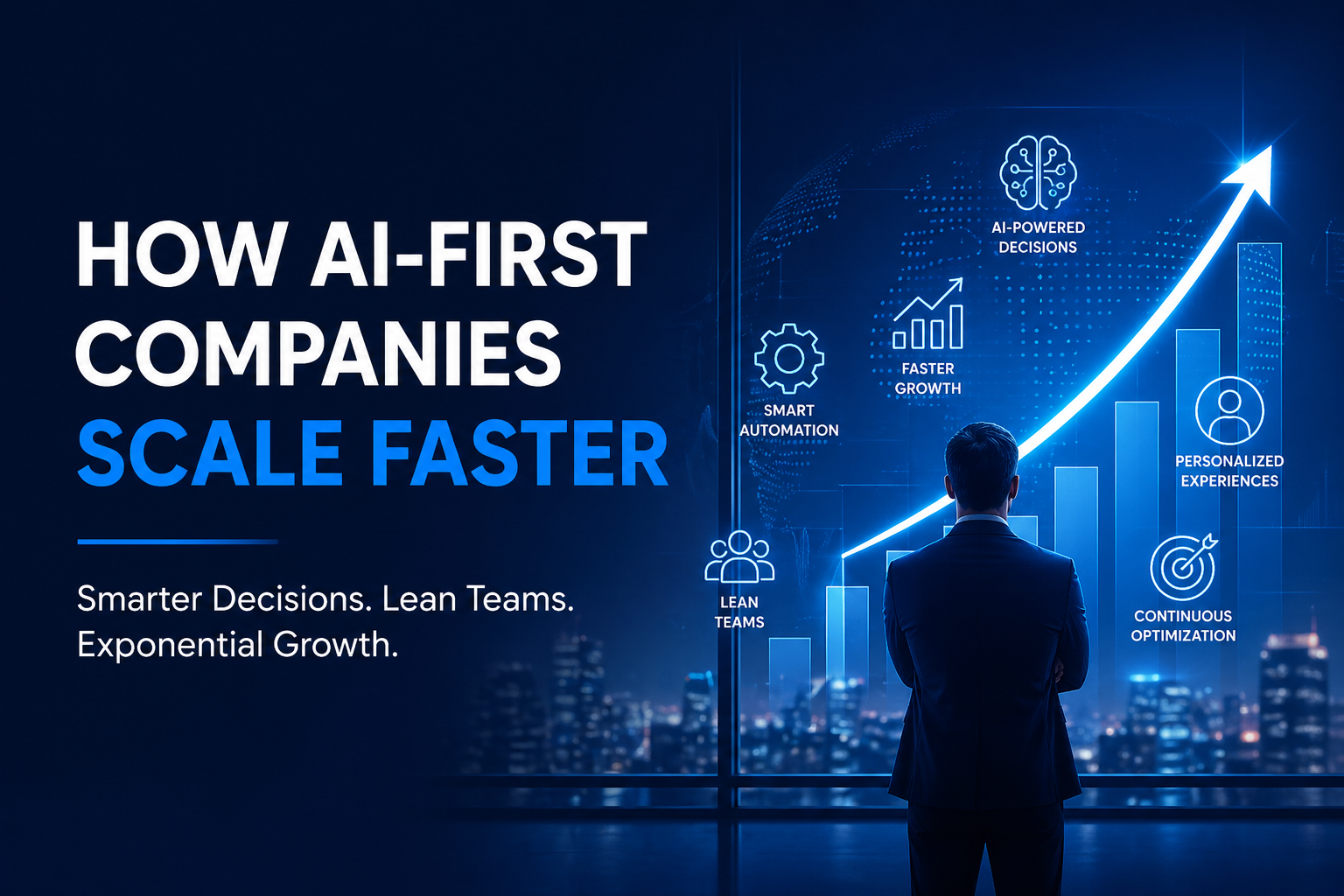
All businesses up until today have aspired to grow. The way in which they accomplished it conveyed that growth till now was primarily based upon personnel, budgetary increases, and stepwise expansion of operations. However, as proved by the incredible speed at which certain businesses are scaling (twice as fast with only one half of the necessary resources), the way in which we will achieve growth will change drastically and dramatically.
The reason for this incredible transformation is that an “AI-first” organization will operate very differently than any other organization in the history of mankind—no longer simply as “a tool” used by a business but rather as the actual “passageway for how a business operates” and will therefore make everything faster, smarter, and cheaper. For all of these reasons, AI-first organizations are subsequently pulling ahead of and leaving behind the rest of the competition.
Speed Becomes a Built-In Advantage
AI-first companies are able to scale more quickly than traditional companies because of their increased operational speed.
Many traditional businesses are highly dependent on human labor for approval processes, for example, lengthy manual processes that are time-consuming (data analysis, reporting, execution, etc.). Therefore, delays build up and result in a loss of time.
Conversely, AI-first companies are able to automate a considerable amount of their operational processes. Therefore, data can be analyzed almost instantaneously; real-time insights will assist with making decisions, and there is no unnecessary delay in executing actions due to the time required.
Data-Driven Decisions Replace Guesswork
Scaling businesses involves hundreds of decisions, including what products or services to sell, who their target audience is, how much to charge, and where to invest. In traditional models, many of those decisions rely on assumptions or small amounts of data.
In comparison, AI-first companies approach this process differently. Instead of acting on guesswork or intuition, each decision is backed by data. AI technologies are able to handle and analyze large volumes of data to uncover trends that may be difficult for humans to find.
When it comes to the benefits of these technologies, they can lead to fewer incorrect choices, improved decision-making, and increased predictability about the outcome of decisions that are made by the organization. As companies make better choices on a consistent basis, scaling of businesses will be much easier.
Lean Teams, Bigger Output
Did you know that some AI-first businesses have shown how quickly smaller groups or organizations can achieve greater results than traditionally larger ones because they can take advantage of the speed at which AI can process information?
For example, by using AI to eliminate many manual labor tasks, such as entering information manually for data entry jobs, responding to customer calls/emails, or generating new content, organizations can free up their employees to concentrate on higher-value activities, like developing strategies or creating innovative products.
As a result, when a small business can give results similar to larger businesses using only a fraction of their resources, they no longer require an aggressive growth strategy through hiring; rather, they can grow on a more sustainable basis that will be less costly.
Personalization at Scale
Customers are looking for personalized experiences, but creating those experiences by hand is very challenging on a large scale. Here is how AI-first companies benefit tremendously over their competition. They use AI to look at how customers behave and then deliver customized experiences to customers regardless of which channel they use to engage with the company.
Some examples include product recommendations, marketing messages, and user interfaces. There is also a positive relationship with business growth resulting from customers feeling that the business understands them.
Continuous Optimization
A traditional company will operate its marketing campaign or strategy by following a fixed cycle (launch, wait, analyze, and then improve), which inhibits growth due to the time required for each cycle in this manner.
AI-first companies are able to continuously optimize their campaigns through a constant cycle of learning from data, analyzing their campaigns, and making improvements. For example, if the marketing campaign underperforms, AI can instantly modify targeting or adjust budget based on real-time performance data. Additionally, if a product’s feature is underutilized, an analysis can quickly provide insight for modification.
Better Customer Insights
In order to grow your business, you have to understand who you are selling to or providing a service to. Companies that utilize an AI-first approach will take it beyond regular data analysis and gain valuable actionable insights into the needs of consumers as well as how to fulfill those needs. They can forecast consumer requirements before the need arises and will also provide guidance on what action to take after a consumer need has been identified, helping you retain those consumers.
Having this level of understanding will help you deliver value to the consumers prior to them requesting it. This will create a strong relationship between you and the consumer, which in turn drives long-term growth.
Faster Innovation Cycles
Scaling would not work without innovation—yet there are many phases during the process of innovation (research, development, testing, and iteration) that take a long time. Companies that adopt AI-first technologies reduce this timeline considerably. They can use AI to run ideas through the testing process and get verification and responses to the proposed solution faster than other firms.
By being able to introduce new features, products, or campaigns at a much faster rate than all firms, companies that are AI-first have the opportunity to stay ahead of competition by continuously innovating.
Agility in a Changing Market
Markets are rapidly evolving with changing trends, customer preferences, and an increasing number of competitors. Businesses that don’t have the ability to adapt at a fast rate will typically be left behind.
AI-first companies are designed with agility in mind; they have systems that can detect changes early, allowing them to react immediately. This could mean making adjustments to pricing, changing their strategy, or looking for new opportunities—all done quickly and easily.
So what does this mean? They don’t respond to change later than others; they are now able to be ahead of the curve. In business, being ahead of the curve means everything!
Conclusion
The companies that put AI first aren’t simply leveraging new technologies; they also have an entirely different way of running their business. With fast speed, lots of data, automation, and a commitment to always improving what they do, they are creating processes designed for scalability.
Consider a larger context. Growth today isn’t all about working harder; instead, it’s about working smarter—and that is possible because of artificial intelligence. Therefore, AI-first companies tend to grow significantly faster than their competitors. And as AI develops and matures, the difference between an AI-first company and a traditional company will only continue to expand.