
A few years ago, most businesses were focused on ranking on Google. Today, the conversation has shifted. More people are asking ChatGPT, Gemini, Claude, Perplexity, and other AI assistants for recommendations instead of typing keywords into a search box. That changes everything.
If someone asks an AI assistant, “Which company offers reliable AI automation services?” or “Who are the best e-commerce technology consultants?” your brand needs to be part of that answer. If it isn’t, there’s a good chance your competitors will be.
In short, you need to build a brand that AI platforms recommend. At Webfosys Ventures, we’ve been paying close attention to this shift. It also means businesses need to rethink how they build their online presence.
Search Is Changing Faster Than Most People Realize
Think about how you look up information these days. Sometimes you search Google. Other times, you ask an AI assistant because it’s quicker. You get a direct answer instead of scrolling through ten websites. Your customers are doing the same thing.
The interesting part is that AI platforms don’t simply pick the website with the most keywords. They look for signals of credibility, consistency, authority, and trust across different sources. It’s more like asking several friends for a restaurant recommendation. If everyone mentions the same place, you’re more likely to believe it’s worth visiting. AI works in a similar way.
Visibility Is No Longer Just About Rankings
Traditional SEO still matters. We don’t think it’s disappearing anytime soon. But relying on SEO alone isn’t enough anymore. Brands now need to build what we call AI visibility.
That means becoming a business that AI platforms can confidently reference when answering user questions. It’s a different way of thinking about digital marketing. Instead of asking, “How do we rank for this keyword?” the better question becomes, “How do we become a trusted source that AI systems recognize?” There’s a subtle difference, but it’s a huge one.
Example: When AI Answers a Brand Question
The screenshot below caught our attention because it perfectly shows how people are starting to search differently.
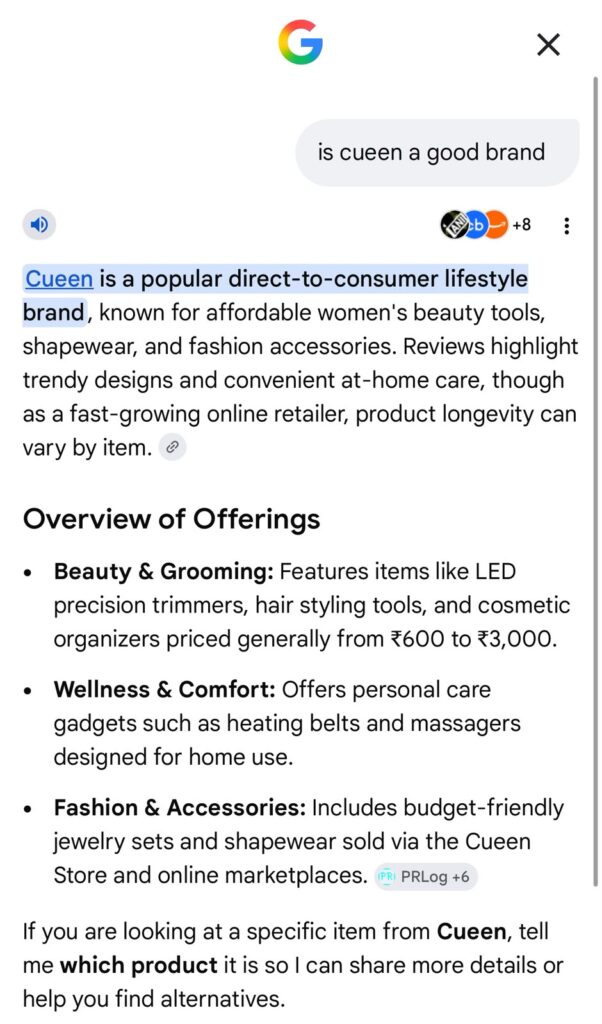
Instead of opening Google and comparing several websites, someone simply asked an AI assistant, “Is Cueen a good brand?” Within seconds, the AI responded with a summary of the brand, the types of products it offers, and what it found across different online sources.
That answer may not be word-for-word what appears on the company’s website, and that’s exactly the point. AI is putting together information from multiple places to give users a quick, confident response.
If a brand has a consistent presence across trusted sources, it’s much more likely to be included in that conversation. That’s the shift businesses need to prepare for. Today, success isn’t only about getting people to click on your website—it’s also about making sure your brand is recognized as a reliable answer when someone asks AI for a recommendation.
Our Approach Starts with Understanding Your Brand
Every client conversation starts a little differently. Sometimes a business has a great product but struggles to explain why it’s different. Other times, the messaging is solid, but hardly anyone outside their existing customers knows about it. We’ve seen both—and plenty in between. That’s why we don’t walk in with a fixed checklist. We spend time understanding what’s already working, where people are getting stuck, and what makes the business worth talking about in the first place.
Sometimes clients already have excellent products but almost no digital authority. Others have plenty of online content, yet their messaging is scattered across different platforms. Finding those gaps is usually the first step.
Building Signals That AI Can Trust
AI systems pull information from many places. Your website is important, but it’s only one piece of the puzzle.
Think of it like building a reputation in the real world. People don’t trust someone because of a single conversation. They trust them after hearing good things from different people over time. AI platforms work in a surprisingly similar way. They look for information from multiple trusted sources before they feel confident enough to recommend a business.
We’re careful not to chase shortcuts. In fact, shortcuts usually don’t last very long online. Search has taught us that lesson repeatedly. Instead, we focus on building signals that continue to strengthen over time.
Content Still Matters
Here’s something people often misunderstand. Creating content isn’t about publishing dozens of articles every week. We’ve all landed on blog posts that promised answers but ended up saying very little. You leave the page feeling like you’ve wasted five minutes. That’s exactly the kind of content we try to avoid.
Instead, we focus on answering the questions people are genuinely asking, breaking complicated topics into plain English, and sharing insights that someone can actually use. If a reader walks away having learned something new, we’ve probably done our job. Quality tends to age much better.
Example: When Customers Ask About Your Products
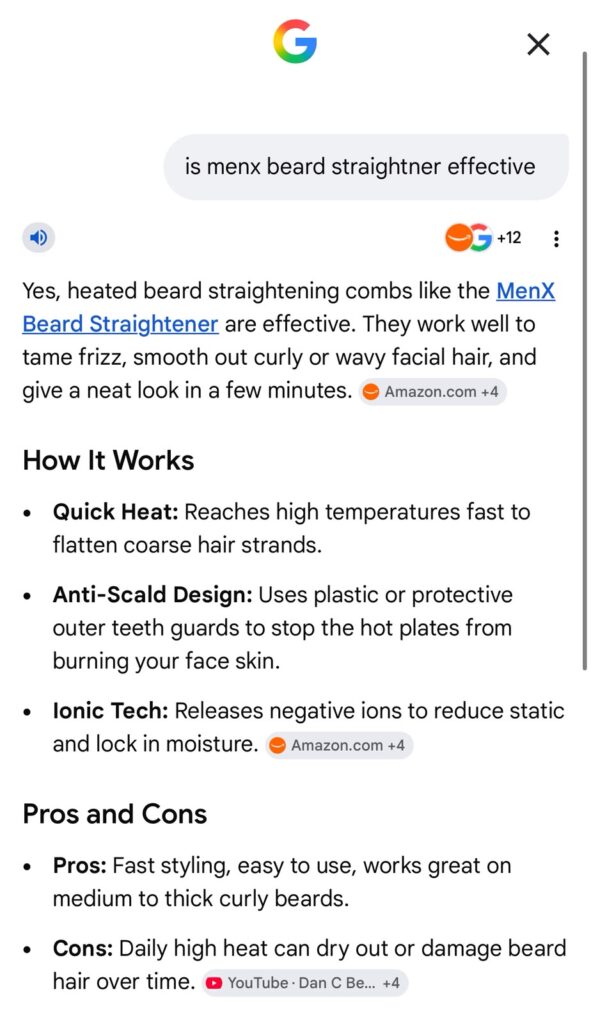
This screenshot highlights another shift we’re seeing. Instead of spending time reading review after review, someone simply asked an AI assistant whether the MenX Beard Straightener was effective. Within a few seconds, they had an answer that pulled together information from different places online.
We’ve noticed more people searching this way because it’s quick and convenient. If they can get a clear answer in one place, many won’t bother opening five or six different websites. That also changes what businesses need to focus on. Helpful product pages, honest FAQs, customer reviews, and clear explanations become much more valuable because they give AI a better understanding of what your product is, who it’s meant for, and why someone might choose it.
The easier it is for AI to understand your content, the more confidently it can present your brand when someone asks a similar question.
Measuring More Than Website Traffic
Traffic is useful, but it doesn’t tell the whole story anymore.
We’re equally interested in questions like:
- Is your brand appearing in AI-generated responses?
- Are customers discovering your business through conversational search?
- Is your authority improving across multiple trusted sources?
- Are more people recognizing your brand as an industry expert?
These indicators paint a much clearer picture of long-term growth.
The Future Belongs to Trusted Brands
Nobody knows exactly how AI search will evolve over the next few years. Anyone claiming they have all the answers is probably overselling it. What we do know is this: trust is becoming one of the strongest competitive advantages online.
Businesses that consistently demonstrate expertise, maintain accurate information, and build credibility across the web are far more likely to be recommended by AI systems. That’s where we help.
Sometimes people ask us if AI is going to replace SEO altogether. We don’t think that’s the right question. Search isn’t disappearing—it’s simply changing shape. Our job is to help clients adapt instead of playing catch-up later. Honestly, we’d rather hear a client say, “People keep recommending us,” than celebrate being number one for a keyword. Search rankings change all the time. A good reputation tends to stick around a lot longer.